
By: Naraya Lamart and Ollie van der Zee
As part of our decommissioning series, we took a macro view of the obligations on stakeholders Offshore Petroleum and Greenhouse Gas Storage Act 2006 (Cth) (2006 Act) and the different kinds of contracts involved in topside and substructure removal and onshore recycling.
Many in the industry will be aware that the floating production storage and offloading (FPSO) Vessel, Northern Endeavour, left the left the Laminaria and Corallina oil fields, in the Timor Sea, at the end of September 2025 destined for Singapore. That was the first leg of her decommissioning journey, and she will ultimately be finally dismantled in Denmark. Albeit under a slightly different regulatory regime, with the Commonwealth of Australia as the approval holder rather than the titleholder, this nonetheless presents a convenient case study of some of the different considerations and contracts involved in the decommissioning process.
The Northern Endeavour
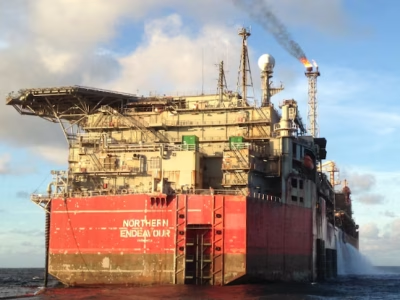
Image Source: ABC News
The Northern Endeavour was a 274m long FPSO facility permanently moored for the last 26 years between the Laminaria and Corallina oil fields, about 550km northwest of Darwin in the Timor Sea. The decommissioning of the Northern Endeavour is not without controversy as, following the liquidation of the former private owner, the Commonwealth took over ownership and, as a result, became responsible for the Northern Endeavour at the end stage of its life and the resultant decommissioning obligations.
Recent controversy has centred more on the decision to award the recycling contract to Danish company Modern American Recycling Services Europe (MARS), with the dismantling and recycling of the Northern Endeavour taking place in the Frederikshavn ship recycling facility. Local Australian interests had likely hoped for this process to remain in Australia, but the Australian government ultimately decided to dry tow her to Frederikshavn for dismantling because there are no purpose-built facilities in Australia equipped to recycle a vessel as large and complex as the Northern Endeavour.1
Logistically, this means that the Northern Endeavour has to travel over 15,000nm to Frederikshavn to commence dismantling. The first stage of the journey involved the Vessel being towed by the tug, Normand Sirius, to a Singaporean dry dock. There the Vessel was readied for the next leg of her voyage – she sailed at the end of January 2026 headed for transit through the Suez Canal towards the end of February 2026, all going well. This second stage of the journey is being undertaken by the semi-submersible heavy transport vessel, the Hua Rui Long – she is the third largest semi-submersible heavy transport vessel in the world, making her among the few vessels that are large enough to carry something as long and heavy as the Vessel.
In terms of the contractual arrangements for the two legs, in this article we consider what contractual terms might have been used for the tow of the Northern Endeavour to Singapore. In our next article, we will consider the standard form contracts that might be used for the second leg of the voyage to Denmark
The Normand Sirius
For this article in our series on decommissioning, we noted a number of different standard form contracts that might be used depending on the nature of the operation. For towage, we suggested that parties might use TOWCON or TOWHIRE forms.
Each form has its advantages but, for the purpose of this article, we will assume that the Northern Endeavour’s journey to Singapore under tow from the Normand Sirius was performed under TOWCON 2008 or similar terms.
Below we consider some of the terms to which the hirer of a tug (Hirer) should pay close attention.
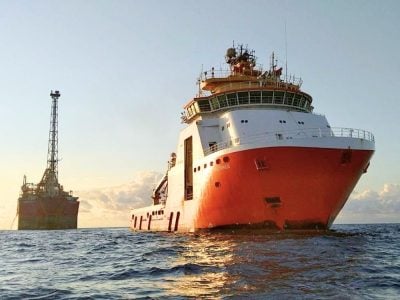
Image Source: Department of Industry, Science and Resources
Knock-for-knock
It won’t come as a surprise to note that a cornerstone of TOWCON 2008 is that liabilities under the form are dealt with on a knock-for-knock basis and reflects standard practice in the offshore industry.
Broadly speaking, this regime means that each party bears the risk of loss and damage caused to its property regardless of who might be to blame for a particular incident. The philosophy behind this in the field of marine and offshore projects is that, because of the complexity of operations and challenging operating conditions, incorporating knock-for-knock principles evenly distributes the risk and reduces the scope for legal action.
It is therefore essential, for anyone engaging tug services under TOWCON 2008 or similar terms, to protect against the risk of property damage through taking out appropriate marine insurance.
Price and payment
The price of towage is dealt with in box 33 of part 1 of the TOWCON 2008 form and by clause 3.
Simply put, lumpsum payment is due at the time of each of the stages identified in box 33 and is deemed “fully and irrevocably earned” at that time, on “lost or not lost” terms. In other words, the various lumpsum payments will be due at each milestone whether or not the tow is subsequently delivered and even if subsequent performance of the towage is rendered impossible.
As with freight under standard voyage charterparties, tsporehe payment of the lump sum remuneration is sacrosanct and deductions or set-off against the payment of the lump sum is impermissible under clause 3 or as a matter of law.
Additional Charges and Extra Costs
Aside from the lumpsum payment of freight, clause 9 requires the Hirer to appoint agents at the place of departure and at the destination and to pay “all port expenses, pilotage charges, harbour and canal dues and all other expenses of a similar nature” and the costs of any assisting tugs that the destination Port Authority might deem necessary.
This is important to note because, while the Hirer might dispute the need for assisting tugs, if required by Port Authorities, there is very limited scope for debate. Consequently, to avoid any surprises, operators should obtain written confirmation from the destination port agents at the time the towage contract is being negotiated.
Likewise it is important to be aware that, under clause 16 the TOWCON 2008 form, unless the result of the tug owner’s negligence, the Hirer is liable for replacement costs of any towing gear and accessories should such equipment become lost, damaged or unserviceable during the voyage.
Delay payments Canal and Restricted Waters Transit
The TOWCON 2008 form has several provisions dealing with instances of delay for which the Hirer is liable to compensate the tug owner.
Clause 7 applies to canal and restricted waters transit. At time of fixing the tug’s employment, the parties will stipulate in box 23 the contemplated route and whether this will involve transit through canals or restricted waters. While the Hirer will be granted free time for such transit, if this is exceeded and has not been caused by the tug owner, the Hirer is liable to pay for the extra transit time at the rate agreed in box 30, as well as other documented extra expenses.
Likewise, if the need for a deviation or slow steaming arises, for example, to put into a port or place, to seek shelter, or deviates from the original route as set out in box 23 on account of actual or forecasted weather conditions, the Hirer is liable to compensate the tug owner at the rate agreed in box 30 for all additional excess time caused by the slow steaming or deviation.
Time for Suit
For any claim outside of the knock-for-knock regime in clause 25, clause 31 requires strict adherence with the time limits for both notifying a claim and filing suit.
For any such claim arises, the claim must be notified within 6 months of delivery of the tow or of the termination of the towage.
An action then must be commenced within one year from when the cause of action arose.
Failure to comply with both of these requirements will result in “all rights whatsoever and howsoever [being] absolutely barred and extinguished”.
Depending on whether the parties have agreed LMAA arbitration in London, SCMA arbitration in Singapore, of before Australian courts, it is important to consider how in each of those instances a suit is commenced. For example, arbitration could be commenced by requiring the other side to appoint its arbitrator (and this can vary from jurisdiction to jurisdiction) whereas court proceedings would require the filing of a claim.
What’s Next?
In our next article, we will consider the second leg of the voyage to Denmark and the carriage of the Northern Endeavour on HEAVYCON 2007 aboard the semi-submersible heavy transport vessel, the Hua Rui Long.
Key Contacts and Updates
Stay tuned for our future articles where we will take a deeper dive into offshore oil and gas decommissioning. If you have any questions or comments, please feel free to reach out to our authors.
Alternatively, please complete the form below to subscribe to our Decommissioning Series.